150 · THE HERITAGE JOURNAL
Milestones: Winchester Rifles Through the Years
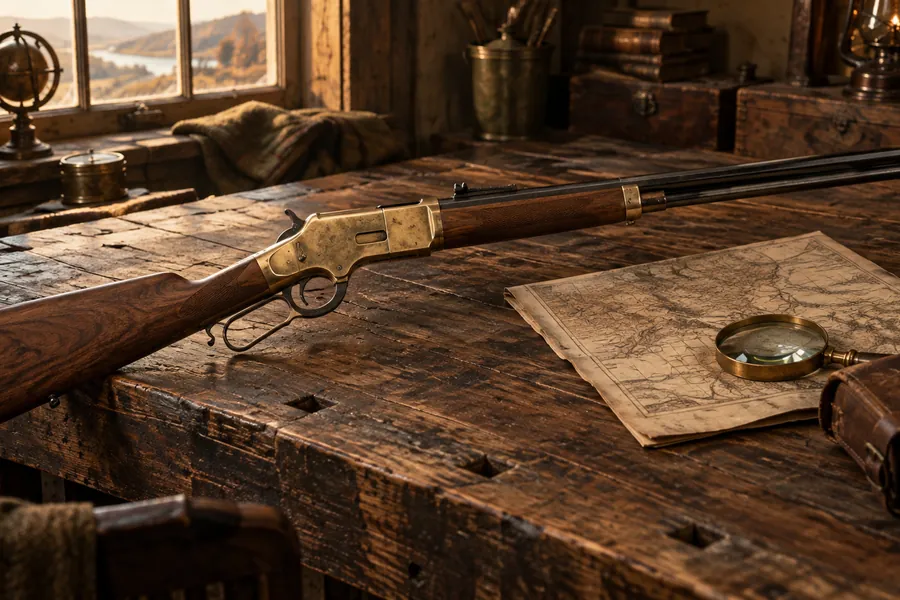
Winchester’s history is easiest to understand through a handful of models. Each one solved a problem of its day, and together they explain why the name still carries weight with collectors and hunters.
1866: the “Yellow Boy”
Oliver Winchester’s company grew out of the New Haven Arms Company, maker of the Henry rifle. The Model 1866 improved the Henry with a loading gate on the side of the receiver and a wooden forend, which made it far easier to load and carry. Its bronze-alloy receiver gave it the nickname “Yellow Boy”. It fired the .44 Henry rimfire cartridge and established the lever action as Winchester’s signature. Read more in our article on why the Model 1866 was called the Yellow Boy.
1873: “The Gun That Won the West”
The Model 1873 moved to an iron, later steel, receiver and to centre-fire cartridges, most famously the .44-40 (.44 WCF). Because the same cartridge could be used in popular revolvers, a rider could carry one kind of ammunition for both. The Model 1873 became the best-known rifle of the frontier era and the subject of the marketing line that stuck to it for good.
1885–1886: the Browning years
Winchester bought a remarkable series of designs from John Moses Browning. The Model 1885 single shot and the Model 1886 lever action, strong enough for big cartridges such as the .45-70, began a partnership that also produced the Model 1892, Model 1894 and the Model 1897 shotgun.
1894: the deer rifle
The Model 1894 is probably the most familiar Winchester of all. Chambered from 1895 for the new smokeless .30-30 Winchester cartridge, it became the classic North American deer rifle. Production ran into the millions, making it one of the best-selling sporting rifles ever made.
1895: the box magazine lever action
The Model 1895 used a box magazine instead of a tube under the barrel, so it could safely handle spitzer (pointed) bullets and powerful military cartridges. Theodore Roosevelt took Model 1895 rifles to Africa, and the Russian army ordered large numbers chambered for its 7.62×54R cartridge during the First World War.
1897 and 1912: the pump shotguns
The Model 1897 pump shotgun, with its exposed hammer, served hunters for decades and went to war as the “trench gun”. The hammerless Model 12, introduced in 1912, earned a reputation for smooth reliability and remained in production for most of the century; many shooters still consider it the finest pump gun ever built.
1936: “The Rifleman’s Rifle”
The bolt-action Model 70 brought Winchester into the modern big-game era. Its controlled-round-feed action, adjustable trigger and wide range of chamberings made it a favourite of hunters and target shooters, and earned it the “Rifleman’s Rifle” title.
1940s: rifles for the war
During the Second World War Winchester produced M1 Garand rifles and developed the M1 Carbine, a light semi-automatic rifle that became one of the most widely issued US weapons of the war. See The Veteran for more.
1964: the pre-64 line
In 1964 Winchester changed its manufacturing methods to cut costs. Collectors still draw a sharp line between “pre-64” rifles and later production, especially for the Model 70 and Model 94. Our article on pre-64 versus post-64 Model 70 rifles explains the differences.
2016: 150 years
The 150th anniversary brought commemorative models, a short film series and events across the country. Commemorative rifles from this and earlier anniversaries are covered in our collecting and auction guide.